
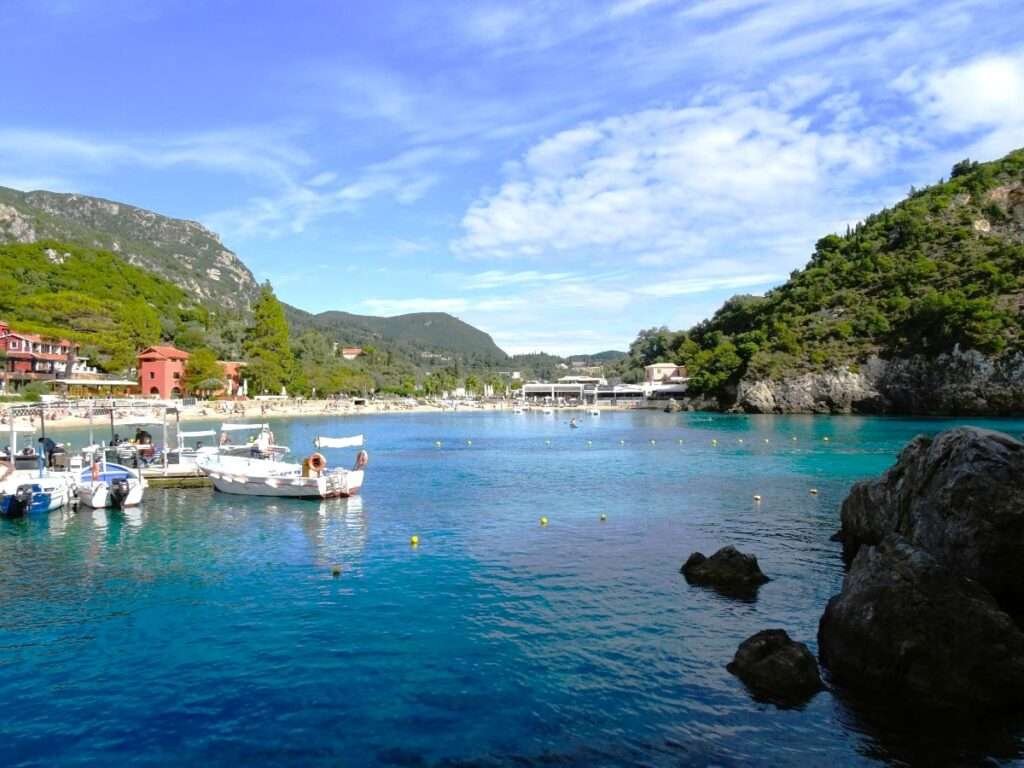
Stormy squalls raged as our plane took off from Exeter Airport. Surprisingly, we only had to keep our seatbelts fastened for a short while, and the further we flew, the more the weather calmed. From the moment we landed in Corfu, it was hot and sunny. Bravo!
Roads from the airport to Ermones run through flower-decked villages, with buildings painted in soft terracotta and buttermilk hues. In half an hour, we arrived at our accommodation on the island’s spectacular west coast, and Mr Word Loft and I were delighted.
The hotel hugs the side of stepped cliffs that lead down to a shingle beach. From our balcony, I gasped at the dynamic scenery. Vast slopes lush with vegetation, especially olive and cypress trees, lead down to the cove and the glittering Ionian Sea. Waves shushed, and cicadas sang.
It’s a steep trek to and from the shoreside. However, an eight-person funicular chugs along rails over the rocky escarpment at ten-minute intervals, taking folk to and from the secluded bay enjoyed by swimmers, sunbathers and a scattering of cats. Fed and cared for by the café staff, the friendly young animals appeared healthy and were happy to share a sunbed if invited. Of course, I couldn’t resist their cuteness.
On other occasions, we read, wrote and people-watched on poolside terraces overlooking the immense hillside, which we discovered was Mount Agios Georgios.
Our resolve not to do much throughout the week wavered, and we booked an excursion to see Achillean Palace and Palokastritsa. The palace was built in 1889 in the village of Gastouri for Empress Elisabeth of Austria, her refuge when her son died. The property was closed for renovations, but the estate and gardens are open and celebrate Greek mythology, specifically Achilles.
The empress was well educated, but superstitious, and believed the Greek gods portrayed in statues and art would bring her good luck. For instance, Medusa’s head is engraved at the entrance to ward off evil spirits. And at the bottom of the park, a gargantuan sculpture of Achilles surveys the panorama, offering protection.
The flowerbeds and trellises brim with colour. Hibiscus, bougainvillaea, and enchanting jasmine with its tiny starlike blooms and sweet fragrance.
We had already savoured kumquat liqueur, so we were looking forward to the forthcoming venue: a kumquat distillery and craft outlet where we sampled two types of liqueur made from the skin or the flesh of the petite citrus fruit. The trees originated in China and Japan and were planted in the mid-19th century. By the 1960s, jam, chutney, or preserves in syrup were in production.
Soon, we were driven to a 13th-century Greek Orthodox monastery dedicated to the Virgin Mary. Its Byzantine architecture is breathtaking, and the church’s interior is magnificent. The altar and walls are embellished with precious metals and icons, and a tranquil aura prevails. Outside is just as exquisite; shrubs and trees still blossom in pink, purple, blue and yellow around archways and in quaint niches. A door leads to the museum where artefacts and rare books are displayed.
At the quayside, we lunched in Palokastritsa resort’s centre and found a table by the water. Fish swam in ripples and families threw in leftover pizza dough. Suddenly, we were startled by flashes of grey and orange as a moray eel snapped powerfully at the scraps as well.
An hour was allocated to us. Some chose boat trips, weaving in and out of caves. Others visited the aquarium, but we explored, admired the little beach and mooched around the streets.
Belle Vista was the penultimate location. From the vantage point, the seascape is stunning, with an islet and craggy coastline where two bays form a large heart with turquoise waves lapping the land.
Last was the olive oil mill, store and museum. The latter was rustic, with tools, a cart and presses from yesteryear. An informative tour, sample tasting and a run-through of merchandise followed. There was much to choose from, ranging from cosmetics to culinary products. Now, I’m imagining all sorts of dishes that I can cook this weekend with the rosemary-infused oil.
After an eventful day, we returned to relaxation mode for a couple of days, but planned a trip into the Old Town before the week’s end.
Lucky us. A festival was to be held there. Oxi Day, commemorating Greece’s involvement in WWII after refusing to surrender to the Axis powers in 1940. Like all respectable tourists, we arrived just before the parade began and found ourselves at a park with a round, columned monument reminiscent of a classical Greek temple. Participants and spectators gathered. A number wore white and blue like the Grecian flag, and a few wore the country’s national costume. Some girls donned long skirts and pretty blouses, and boys wore tailored shorts and jackets.
We watched the lead brass band in their red, gold-braided uniforms, school groups and military contingents. Sidewalks were full of bystanders waving flags and cheering. Our view was limited, so we sauntered to the main town square, eager to get food and drink before the crowds dispersed and clogged up hospitality venues.
It was lovely sitting with locals, sipping my iced smoothie – Raspberry Heaven. The atmosphere fizzed; gift shops sparkled, drawing us through vibrant lanes and alleyways crammed with bijou businesses.
Old Fortress stands sentinel over the town, and in the marina, small boats and yachts give a nautical jolliness. Over the sea, Greece’s mountain ranges create a theatrical backdrop, forging an everlasting memory of an incredible holiday.
Until next time,
Sue. X