
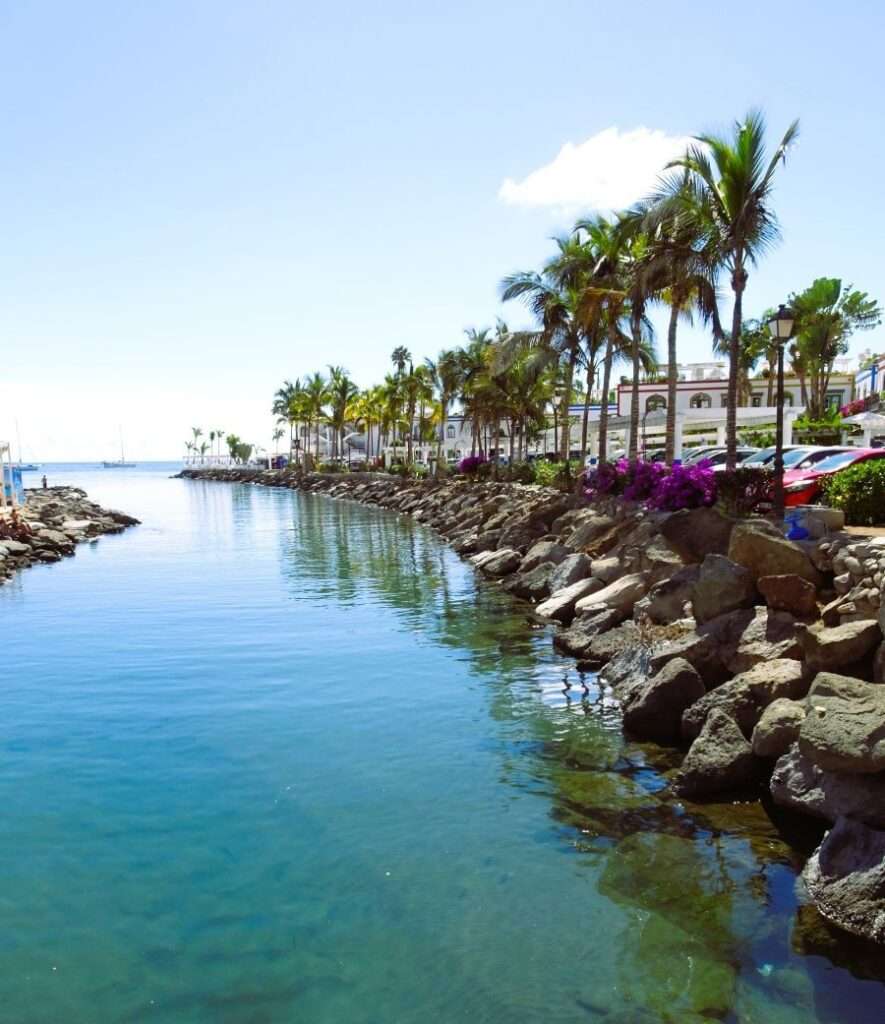
After a hectic year, we needed to re-energise. At short notice, we booked a holiday in Gran Canaria. We hadn’t been there before, and it seemed like a marvellous idea, so we headed off to the sun for ten days.
I scanned through the travel pocket guide purchased the week before departure and knew we were in for a treat.
Arriving at our hotel in Maspalomas at the southern tip of the island, we booked two excursions and identified locations accessible by public transport.
After a day or two of relaxing and reading beside the swimming pool, we travelled to Playa de Maspalomas – one of the isle’s most popular beaches.
The bus terminates at the resort’s lagoon and famous dune fields, a protected nature reserve. We glimpsed them through long swaying grasses. As enticing as they were, we decided to investigate the sandy terrain on another occasion from Playa del Inglés on the other side of them. So we headed west along the promenade. Traders sell wares displayed on colourful blankets here and there, and restaurants, cafes and hotels line the embankment facing the Atlantic Ocean.
Within minutes, we reached the centre. There are tourist shops, brand-name outlets, and stalls selling handmade crafts, including crochet, macramé, personalised T-shirts, and jewellery.
The beach is alluring; we bought icy drinks and found a shady patch under palm trees. I made myself comfortable on a large pumice boulder and wrote in my new leather-bound notebook while my husband strolled along the surf line. In the distance, ripples peaked in the breeze, and rollers crashed onto the shingle. Pigeons cooed nearby. We had seen a number at our hotel and a nearby park, so I was interested to discover the town is named after them. In Spanish, mas means more, and palomas is the word for pigeons.
Refreshed after our rest, we were eager to explore further. The stone lighthouse, El Faro, was next. It combines a white rectangular building adjoining a tall, slender beacon, erected in the 19th century. It remains active today and vital to shipping.
Behind it is a delightful square and gardens, where a yoga group exercised on the lawns. A pathway leads around a beautiful fountain and sculpture depicting a mythological serpent with a man riding it above spray shimmering over a bed of smooth, round rocks. The area emanates tranquillity with its manmade aqua lake and stream meandering under a footbridge to a floral-decked avenue which loops back onto a lane of shops. We chose a route along the shore and were impressed by elaborate sandcastles and pebble towers created by artists for the public’s enjoyment.
Time flew by. With half an hour to spare, we stopped at a café and relished strawberry cakes oozing with cream, washed down with zingy peach tea, before going back to the bus stop.
Waiting opposite the wetlands was idyllic. We observed all sorts of birds, especially two herons swooping between the bright green water to their nest high up on a platform in the boughs of a barren tree. The spectacular desert-like landscape glowed in the background, and it seemed as if we were witnessing a scene on the African continent instead of Europe.
After reading so many good reviews about Puerto de Mogan, we arrived there early on another morning and were enchanted as we walked down from the bus terminal toward the cove.
Across the bay, the old quarter is freshly painted, the colours reminiscent of spearmint chews. The white quadrangle buildings with dark green shutters have a cooling appearance.
The beach and shops were crammed, so we opted for an amble along the seafront and then headed for the prettiest part. Although people throng the narrow lanes festooned with magenta, pink and orange flowers adorning balconies and archways, it has a villagey atmosphere. Clear canals crossed by elegant footways run between the two ports, one for fishing and the other for leisure. Some bridges have lovelocks attached to the sides by couples to symbolise their devotion and add a romantic element to the surroundings.
The best vistas of the island’s southwest are from the top of numerous steps in the middle of town. The houses and apartments on either side are exquisite, with an arty quality, especially intricate mosaics decorating some of the exteriors. They must have taken ages to complete with a lot of patience.
Clammy from the climb and descent, which was worth every breath, we stopped at one of many bars. It was a barraquito coffee cocktail for my husband, and ice-cold blackberry and black tea for me, before going to find transport at the quayside to take us to Puerto Rico, a few miles away.
Lucky us, we located a glass-bottom ferry just about to leave, so paid our fee and off we sailed. Further out in the depths, kayakers and small sailing boats glided through the waves. A great photo opportunity arose when parasailers touched down in the sparkling sapphire sea, their rainbow-striped parachute canopy ballooning above them.
Along the coastline, the terrain is volcanic. All shades of grey, created from eruptions thousands of years ago, with little white settlements nestling in valleys, and glass box-type apartment blocks hugging the cliffs.
Puerto Rico came into sight. Three standards, the European Union, the Spanish Yacht Ensign and the Canary Islands flags billowed welcomingly at the dock entrance. The crew moored up, and we were ready to explore the resort, which is popular with the sailing fraternity and beachgoers.
Well, Puerto Rico is picturesque and a typical fun spot, but I prefer places with a longer history than one conceived between the 1960s and 1970s. However, no break in the sun would be complete without a boat trip, and the journey there from Puerto de Mogan was magnificent.
Well, we were certainly becoming proficient with the buses, and later in the week, we went to Playa de Ingles to encounter Europe’s curious little desert, which we had glimpsed across the nature reserve and lagoon from Maspalomas de Playa.
It was strange stepping out onto the famous sand hills through the doorway of an outdoor shopping complex and feeling the sand warm between my toes. The dunes resplendent, with rippling, undulating bedforms, are breathtaking, and their vastness is outstanding. There are dedicated trails across the dunes, but I noticed a walkway on the outskirts, higher up with premium views. The heat was immense, so we chose to take in the scenery from there instead of trekking over them.
Bungalows along the way have an enviable aspect. Desert and the Atlantic Ocean, except for a segment near the end of the parade, where the dunes are enormous and remarkably close to the properties that the panorama is hidden behind. I imagine that when they were built, this probably wasn’t the case, but over the years, the weather has reformed the land protected by the Canarian government. The arid region constantly changes. Nature cannot be argued with, and maybe the dunes will remould in the future, and residents might see the dramatic terrain again from their windows, where the two contrasting habitats meet.
The disappointment of missing a trip to the capital, Las Palmas, due to a stomach upset was superseded by an outing to the island’s mountainous region.
The territory is much greener than the south, where concrete and imitation grass are abundant, due to the scarcity of rain caused by climate change. But back to our sightseeing in the lush countryside.
First stop, Teror. Bunting, the colours of the town’s flag in yellow, emerald and white crisscross the plaza and flap merrily in the breeze between mature trees.
It was splendid to be in an old-style Canarian locale, at last. The Gothic Basilica de Nuestra Señora del Pino, with its octagonal tower, was the first religious building we saw during our stay.
In the streets, it was refreshing to see locals chatting with cheesemongers, delicatessens, greengrocers, and other food outlets as they shopped. The gift shops sell stock such as pottery, designer clothing, and contemporary basketware, rather than mass-produced goods.
With a packed schedule, we couldn’t go to the museum, and we joined our group, boarding our allotted six-seater passenger carriers, travelling in a convoy to the following destination.
Passing fascinating settings, we drove through the impressive Valley of a Thousand Palm Trees, and our driver-guide brought our attention to banana plantations and a camel farm. The winding road was intriguing. Olives, figs and eucalyptus trees grow in vegetation at the sides. The latter isn’t native to the country but provides shade, and its deep roots delay soil erosion.
The second stop was at the smaller village of Tejeda, here the key thoroughfare is pedestrianised with a church at the end. As we sauntered to the heart of the community, loud music struck up from a loudspeaker system. No one was sure why, but the Spanish tunes enhanced the ambience as we admired nearby sweeping slopes rich with almond trees, nuts and seeds, a source of the local economy.
Back on the road, it took only a few minutes before reaching a captivating viewpoint. Luck was on our side, as it’s usually misty at that height, but forty-five miles away in Tenerife, Mount Tiede was visible. Its summit, piercing a swathe of clouds, is twice as high as Gran Canaria’s highest peak.
A superior outlook over the volcanic, carved landscape is spectacular, with many prominent rock formations. We saw named monoliths and geological features on the way to Fataga. The most memorable is one known as the Sleeping Man, on which locals have based legends.
Lunch in Fataga was impressive, savouring traditional cuisine. Starting with sumptuous cheeses and chutney, served with chunks of bread dipped into mojo and aioli sauces. The restaurant gave a choice for the main course – chicken breast, veal or fish with vegetables. Dessert was bland but soothing on the digestive system, especially if suffering from travel sickness after all the twists and bends. Gofio mousse is a typical sweet Canarian recipe made with toasted grains, which are eaten with other meals too. I had been sprinkling the powdery form liberally over yoghurt and fruit at breakfast.
Our appetites satisfied, we carried on to an aloe vera plantation.
Exhilarated by the sight of the yellow spider-like cacti set out in rows at the base of a mountain, I was eager to learn more. The Finca Canarias staff explained that the plant is grown organically, and demonstrated the gooey translucent substance seeping from the thick fleshy leaves when cut. The aloe vera content in remedies is as high as 98%, the remainder 2% being a natural preservative. Of course, we couldn’t leave without buying anything, and I’m very pleased with the items I purchased.
The whole experience was the perfect conclusion to our Gran Canaria sojourn.