


After Storm Goretti swept through the Southwest, I was unhappy to hear that Trelissick was closed due to fallen trees and debris. It is one of my favourite Cornish National Trust properties. The weather had taken its toll, but on hearing that it had reopened, Mr Word Loft and I were eager to go back.
After the staff’s hard work in the clear-up operation, returning was delightful. On my last trip there, I recall writing a blog post, Summertime at Trelissick, but I hadn’t realised it was four years ago. No wonder we had missed the place, and it seems that the grounds are going to be expanded upon, according to an information notice just inside the entrance. I’m looking forward to seeing the planned fruit garden and reestablished walled garden – exciting times, indeed.
The ancestral home opens again at half term, but the park and woodland trails are more than sufficient with a different verve.
The majority of winter’s hues are subtle. Delicate snowdrops bejewel the ground, and deciduous trees and shrubs’ bare and winding branches are admired before new growth bursts forth. For other plants, colours are already vivid, such as camellias and rhododendrons. Their pinks and reds are uplifting, while the magnolia buds’ gentle tones wait in the wings, preparing for their performance, along with tender daffodil spears.
A garden bridge, lawns, thatched-roof shelters, stone cottages, and an enchanting engine house renovation make idyllic topics for watercolour paintings.
In the season of rest, the sleeping orchard with its rustic wooden apple press gazebo is pretty. The trees include a mixture of Cornish apple varieties; their boughs, twisted and knobbly, are encrusted with lichen. Birds trilled, and a black cap watched shyly, perched high in a hedge as we carried on through The Dell. A squirrel scampered in the undergrowth as the sun warmed the earth, and a robin fluttered past my shoulder.
The King Harry Ferry waited on the opposite bank of the River Fal as we tramped downhill. The lane was deserted, unlike the bumper-to-bumper queue of cars on our summer visit.
At the bottom, we found a little public pathway approximately a hundred metres away from the slipway, where we had the perfect observational spot as the vessel sailed by. As well as foot passengers and cyclists, it can hold up to thirty-four cars, and connects to the Roseland Peninsula, saving a twenty-seven-mile road journey as well as providing stunning river and countryside views.
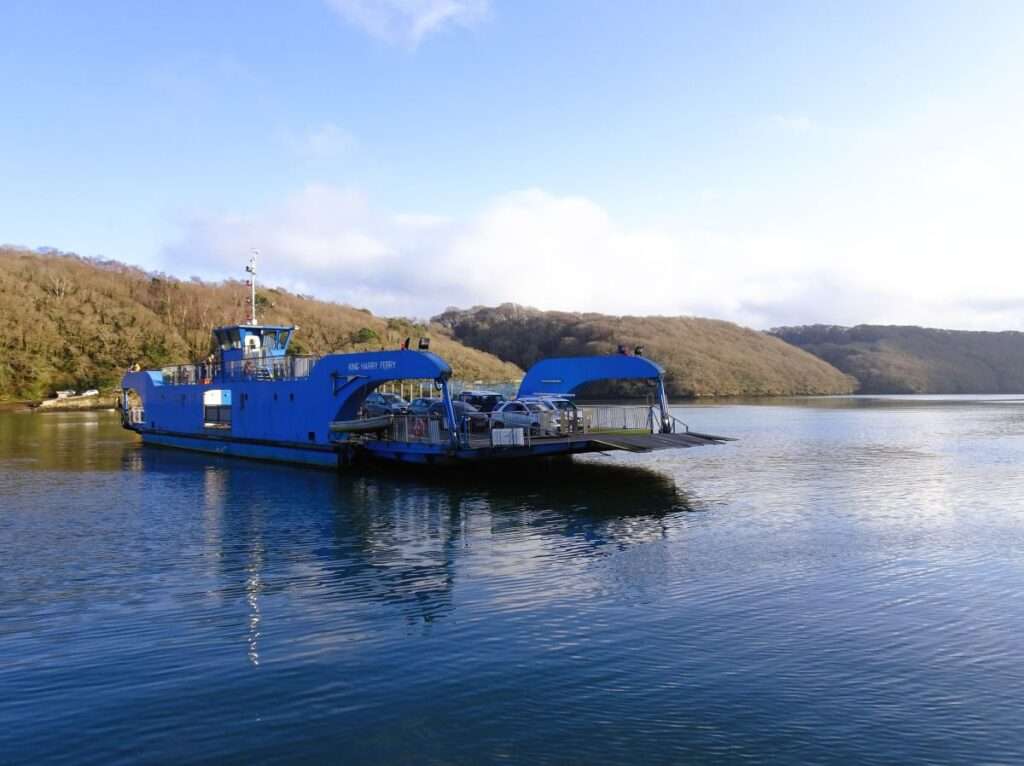
Other types of ferries have been used throughout history, such as rowing boats and a manually worked barge. The King Harry Steam Ferry was established in 1888, and the clinking and clunking as it is pulled on chains across the passage has been heard ever since, although these days it is motorised. Its metallic rhythmic sound reverberated up the valley as we trudged back up to the Estuary Walk, detouring briefly as we stopped outside the grand house, with its portico and pristine colonnades. Although its shutters were closed for its winter break, it emanated a welcoming ambience. I’m so looking forward to going inside at a later date.
Until my next blog post,
Best wishes,
Sue. X