
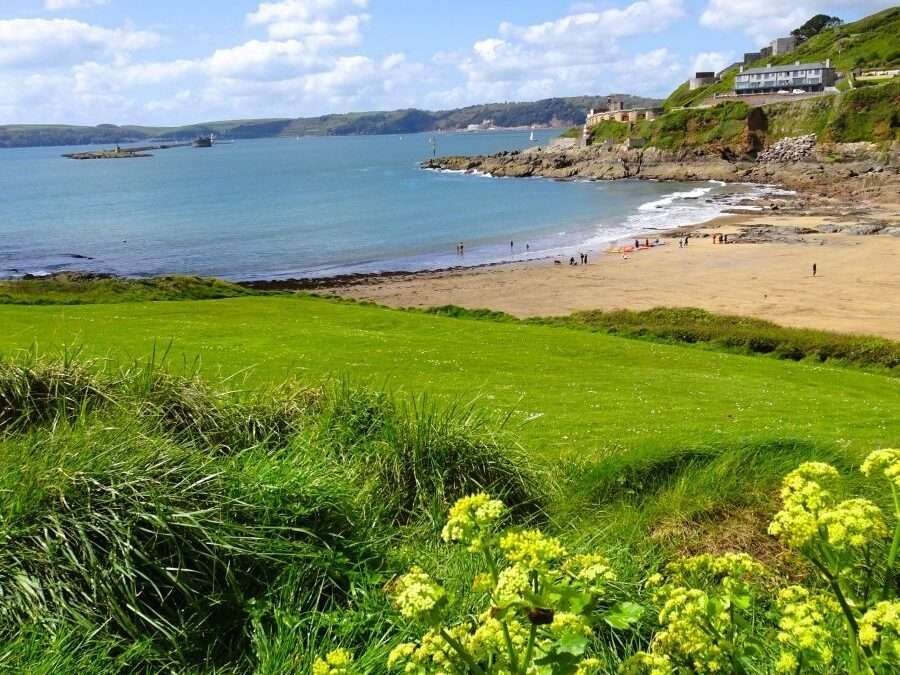
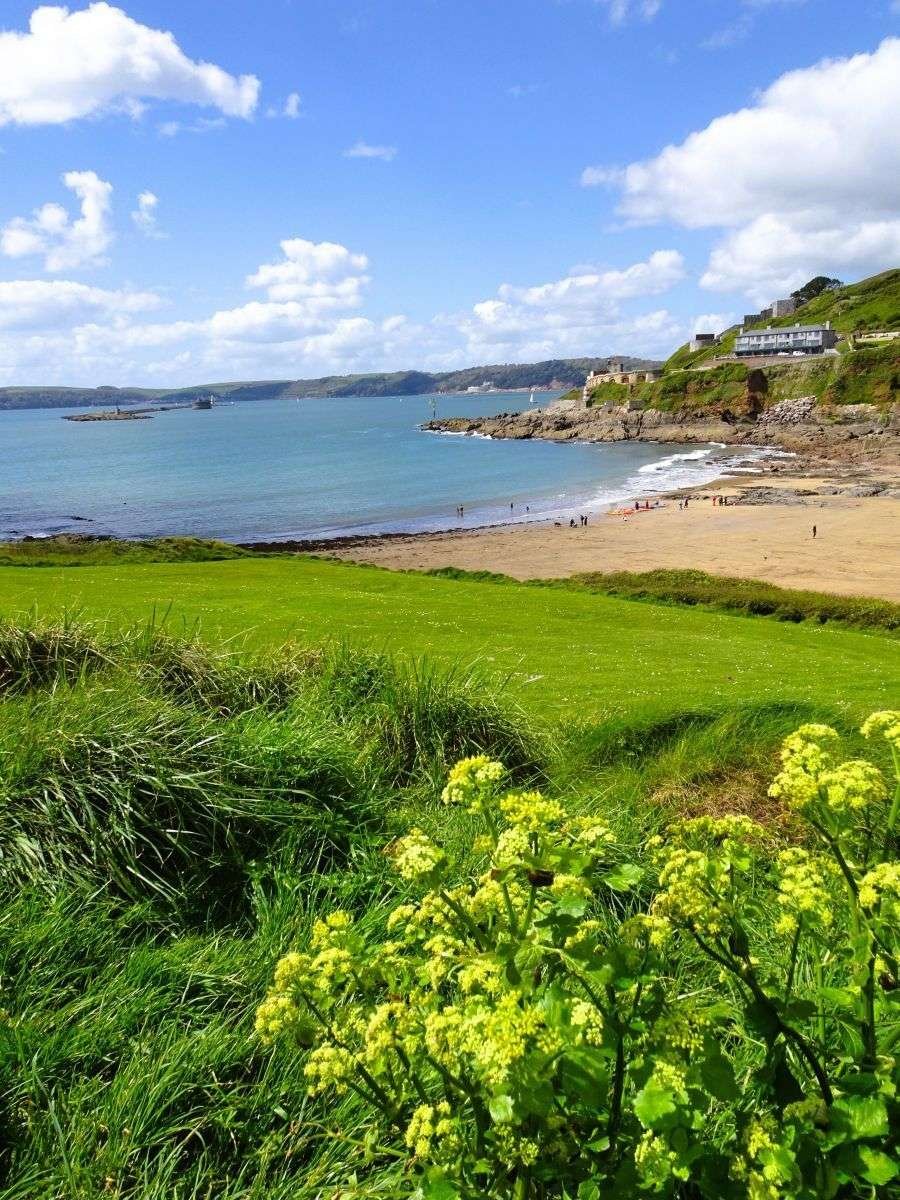
Approaching Crownhill Bay, the scenery is breathtaking. Mr Word Loft stopped the car so I could take a photo of the yellow wavering fields ahead, the sea, and the crescent-shaped Plymouth Breakwater.
We parked near the café and looked down from a grey rocky outcrop to the shore. Intrigued by the breakwater protecting Plymouth Sound and its harbours, I zoomed in with my camera lens for a closer look, noticing a little lighthouse and fort. The latter was built in the late 1890s as a defence against the French, but proved unnecessary and was regarded as a ‘Palmerston Folly’.
We wandered along the road toward Bovisand Bay. Straddled with driftwood and seaweed, a stream trickles over its amber sand; an idyllic setting for children to have safe adventures.
The landscape is strewn with buildings and edifices, evidence of the vicinity’s military history.
High on the headland, Staddon Point Battery is most dominant; its three tiers took two years to build, and the site was completed by 1847. We were on the lane below, and beside Bovisand Fort, constructed of Dartmoor granite at a slightly later period. Adjacent is a row of charming slate-hung coastguard cottages with palms growing in front of the repurposed seaside homes. We would have loved to explore more, but because of the heat, we decided not to and turned back.
Taking another route, along a small section of the South West Coast Path, the refreshing salty breeze was welcome. We came upon ‘Old Man Bovi’. A driftwood sculpture wearing a crown decorated with sea glass and shells made us smile. However, he was delivering a serious message engraved on a plaque fixed below his rusty chain dreadlocks. “The Old Man Bovi says, keep our sea plastic free! Thankee M’dears.”
Hear, hear! I agree to that.
Until next time,
Sue. X